
For many patients considering knee replacement, the biggest concern isn’t the surgery itself — it’s what life will look like afterward. Specifically: “Will I be able to play the sports I love?”
If golf, tennis, or pickleball are part of your life, the good news is this: the vast majority of knee replacement patients successfully return to these activities, often better than they’ve felt in years. Modern surgical techniques, advanced implant designs, and evolving return-to-sport protocols have made knee replacement dramatically more compatible with an active lifestyle than it was even a decade ago.
The key isn’t whether patients can return — it’s when and how they return safely, in a way that protects their long-term investment in the new knee.
At Dr. Tony Shen’s practice, patients across the New York area — many of whom are lifelong athletes and active adults — receive honest, realistic guidance on what to expect from their knee replacement journey. This post covers what Dr. Shen typically shares with them about returning to golf, tennis, and pickleball specifically.
The Big Picture: Knee Replacement and Return to Sport
Knee replacement was originally developed as a procedure to relieve pain and restore basic mobility — walking, climbing stairs, sitting comfortably. For decades, patients were told to avoid impact sports afterward.
Today, that guidance has evolved. Research has shown that many patients can safely return to a wide range of activities, and modern implants — combined with more precise surgical techniques including robotic-assisted and computer-navigated procedures — have improved both durability and function.
That said, not every sport is created equal. Some activities are considered lower-impact and generally safer for a replaced knee, while others carry a higher risk of implant wear or complications. Knowing where each of your favorite activities falls on that spectrum matters.
General Sport Categories After Knee Replacement
- Recommended / Low-impact: Walking, swimming, cycling, elliptical training, hiking on smooth trails
- Generally acceptable with proper preparation: Golf, doubles tennis, pickleball, low-intensity dance, kayaking.
- Higher-risk / discuss with your surgeon: Singles tennis (competitive), high-impact aerobics, jogging on pavement
- Not typically recommended: Contact sports (basketball, soccer), racket sports played competitively at high levels, jumping-heavy activities
Golf, tennis (typically doubles), and pickleball all fall into the middle category — very much possible for most patients, but requiring the right preparation, gradual return, and modifications to certain movements.
Returning to Golf After Knee Replacement
For most patients, golf is the earliest and easiest return-to-sport milestone. It’s low-impact, involves controlled movement, and can be modified in intensity from putting practice to full 18-hole rounds.
Typical Return-to-Golf Timeline
Every patient’s recovery is different, but a general framework looks like this:
Weeks 1-4: Focus on healing, range of motion, and beginning physical therapy. No golf-specific activity.
Weeks 4-6: Some patients begin light putting on flat surfaces. This is a great, low-stress way to reintroduce the game’s mental and physical rhythms.
Weeks 6-8: Progression to chipping and short-iron swings, typically off a mat or tee, avoiding any twisting or full weight transfer.
Weeks 8-12: Most patients can begin full swings at the driving range, focusing on smooth mechanics rather than power.
Months 3-4: Return to walking 9 holes or riding for 18 holes for many patients.
Months 4-6: Full return to competitive play for most patients, including 18-hole rounds walking the course.
Golf-Specific Considerations
- The lead leg (left knee for right-handed golfers) bears the most stress during the swing — patients who have had their left knee replaced may initially notice increased sensation at follow-through.
- Use a golf cart initially, even if walking the course is preferred. Gradually adding walking mileage back protects the joint.
- Consider a smoother, less powerful swing during the first few months back — the goal is enjoying the game, not maximum distance.
- Warm up thoroughly before every round, especially in cooler weather when tissues are stiffer.
- Custom golf shoes with good support help (avoid metal spikes if possible — softer spike systems reduce joint stress)
Most golf patients report they’re playing better within a year than they had for the years leading up to surgery. Freedom from pain often improves the swing more than any lesson could.
Returning to Tennis After Knee Replacement
Tennis is more challenging than golf because it involves lateral movement, sudden stops, quick starts, and pivoting — all higher-stress activities for a knee. But that doesn’t mean tennis is off the table. It just requires more thoughtful preparation and, for most patients, some modifications to how the game is played.
Typical Return-to-Tennis Timeline
Months 1-2: Focus on core recovery and physical therapy. No tennis activity.
Months 2-3: Some patients can begin gentle ball feeding or wall practice — controlled, minimal movement.
Months 3-4: Progression to gentle doubles rallying with a partner, avoiding hard cuts or full sprints.
Months 4-6: Return to regular doubles play for most patients, with continued caution.
Months 6-12: Return to more competitive doubles or gentle singles for select patients — always in consultation with the surgeon.
Tennis-Specific Considerations
- Doubles is safer than singles. The reduced court coverage significantly reduces sudden sprints, hard stops, and lateral cuts.
- Choose your surface wisely. Clay and soft courts (Har-Tru, Har-Tru Green) are gentler on the knee than hard courts. Grass is also easier when available.
- Modify your movements. Take smaller steps, avoid extreme lateral lunges, and let a doubles partner cover the deep balls.
- Skip the singles ladder — at least initially. Even patients who return to singles typically play more recreationally rather than at high competitive intensity.
- Consider knee support — a sleeve or brace during play can provide comfort and mild stability, though it isn’t structurally necessary.
- Warm up longer than you used to. Ten minutes of gentle jogging, dynamic stretching, and rally practice before competitive play makes a significant difference.
Many patients say tennis becomes more enjoyable, not less, after knee replacement — because the constant pre-surgery pain that limited them is finally gone. The trade-off is playing a slightly smarter, less punishing version of the game.
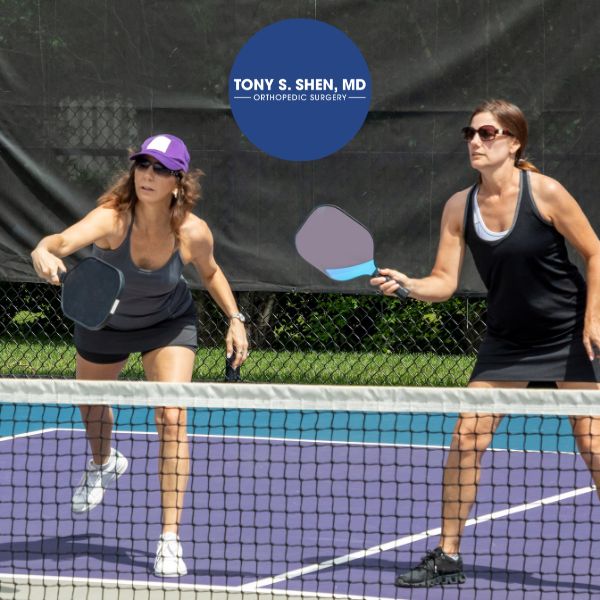
Returning to Pickleball After Knee Replacement
Pickleball has become the fastest-growing sport in America, and it’s especially popular among adults over 50 — which happens to be the same demographic that most commonly undergoes knee replacement. As a result, “When can I play pickleball again?” has become one of the most common questions patients ask.
The short answer is yes: most patients can return to pickleball after knee replacement. But pickleball requires particular consideration because of its unique movement patterns and the fact that many players are still learning the sport when they sustain injuries or aggravate existing joint problems.
Typical Return-to-Pickleball Timeline
Months 1-3: Focus on healing and physical therapy. No pickleball activity.
Months 3-4: Some patients begin gentle at-home paddle work — dinking practice, wall drills, or extremely controlled play.
Months 4-6: Return to social, recreational pickleball for most patients, playing doubles at moderate intensity.
Months 6-12: Progression to more regular play, with continued attention to safe movement patterns.
Pickleball-Specific Considerations
- The kitchen (non-volley zone) is where injuries happen. Rapid forward lunges to reach dinks put significant stress on the knee. Practice moving smoothly rather than lunging aggressively.
- Play doubles, not singles. Singles pickleball requires substantially more court coverage and rapid direction changes.
- Choose competition level thoughtfully. An early return to competitive league play or tournaments is often too much, too soon.
- Pickleball footwear matters. Court shoes designed for lateral movement are essential — running shoes are not appropriate for pickleball and increase the risk of injury.
- Watch for backpedaling. Backpedaling to chase an overhead lob is one of the most common causes of pickleball falls, which can be particularly dangerous for post-surgical patients.
- Play on cushioned courts when possible. Newer dedicated pickleball facilities often have cushioned surfaces that are gentler on joints than converted tennis courts.
- Warm up thoroughly. Ten minutes of walking, dynamic stretching, and drinking practice before competitive games make a significant difference.
Many of Dr. Shen’s pickleball patients play regularly at high recreational levels a year or two after their knee replacement. The key is treating the return as a gradual progression, not a switch flip.
What Every Return-to-Sport Journey Has in Common
Regardless of which sport a patient is returning to, several principles apply universally:
1. Physical therapy is non-negotiable. The single biggest factor in a successful return to sport is completing a thorough physical therapy program. Skipping or shortening PT is one of the most common reasons patients don’t feel as strong as they hoped.
2. Strengthen beyond just the knee. Hip strength, core stability, and ankle mobility all affect how well the knee tolerates athletic activity. Comprehensive lower-body conditioning matters.
3. Progress gradually. The most common return-to-sport mistake is jumping back to pre-surgery activity levels too quickly. Muscles, tendons, and confidence all need time to rebuild.
4. Listen to the body — but not just at the moment. Some soreness after activity is normal. Persistent pain, significant swelling that lasts more than 24-48 hours, or a joint that feels warm or unstable is a signal to pause and consult the surgeon.
5. Communicate with the surgeon. Different patients heal at different rates, and different implants have different considerations. Each patient’s specific return-to-sport plan should be tailored to that individual case, not based on a generic timeline.
6. Stay realistic — and stay motivated. Most patients don’t return to the exact athletic level they had 20 years ago. But they do return to enjoying their sport, often without the pain that had limited them for years.
Frequently Asked Questions
How long after a knee replacement can I play golf?
Most patients can begin putting practice around 4-6 weeks post-surgery, chipping around 6-8 weeks, and full-swing driving range work around 8-12 weeks. Full return to 18-hole rounds is typical between 3 and 4 months for many patients. Individual timelines vary significantly.
Can I play tennis after a knee replacement?
Yes, most patients can return to tennis — though typically doubles rather than competitive singles. The return usually occurs gradually over 3 to 6 months, with attention to court surface, movement modifications, and cautious progression.
Is pickleball safe after a knee replacement?
Yes, for most patients. Pickleball is played by many patients following knee replacement. That said, it requires careful attention to movement patterns (especially at the kitchen line), proper footwear, and gradual return to intensity.
Will my knee replacement wear out faster if I play sports?
Modern implants are designed for active lifestyles, and research suggests that moderate recreational athletic activity does not significantly shorten implant lifespan for most patients. High-impact activities (running long distances, competitive contact sports) may carry more risk. This is worth discussing specifically with your surgeon.
Do I need to wear a knee brace to play sports?
Structurally, a knee brace isn’t needed after a successful knee replacement. Some patients wear a compression sleeve for comfort or mild proprioceptive support, but this is a preference, not a requirement.
Can I return to running after knee replacement?
Long-distance running is not typically recommended after knee replacement due to the repetitive high-impact stress it places on the knee. Some patients jog or run at a brisk pace with careful monitoring, but most surgeons prefer walking, cycling, the elliptical, or swimming for cardio.
How do I know when I’m ready to return to my sport?
Return-to-sport readiness is a combination of factors: range of motion equal to (or close to) the other knee, strength that supports the demands of the sport, minimal to no pain during PT exercises, and clearance from the orthopedic surgeon and physical therapist. It’s not just about calendar time.
What if pain returns when I resume my sport?
Mild soreness after resumed activity is normal, especially in the first few sessions. However, persistent pain, significant swelling, warmth in the joint, or instability are signs to stop and be evaluated. Don’t push through significant pain.
Should I consider partial knee replacement if I’m an active patient?
For some patients with arthritis limited to one compartment of the knee, partial knee replacement may be an option that preserves more of the natural joint. This is a case-by-case decision based on specific anatomy and disease pattern. It’s worth discussing at consultation whether partial or total replacement is more appropriate.
Choosing the Right Surgical Approach for an Active Life
The knee replacement a patient receives matters for long-term athletic function. When considering surgery, factors that can affect the ability to return to active sports include:
- Surgical technique — minimally invasive approaches often lead to faster recovery
- Implant selection — different implant designs are optimized for different activity levels
- Alignment method — personalized alignment approaches customize the procedure to natural anatomy
- Robotic and computer-navigated surgery — advanced technology can help improve precision, particularly for patients who plan to remain athletically active.
- Rapid recovery protocols — evidence-based approaches that can shorten time to return to daily activities
At Dr. Shen’s practice at Hospital for Special Surgery, advanced techniques, including robotic-assisted joint replacement and personalized alignment, are used to tailor each procedure to the patient’s anatomy and goals. For athletic patients, that personalization matters — because the goal isn’t just pain relief. It’s returning to the activities that make life fulfilling.
Ready to Discuss Your Options?
If you’re considering knee replacement and worried about whether you’ll be able to return to golf, tennis, pickleball, or another sport you love, the best next step is a thorough consultation with an orthopedic surgeon who specializes in hip and knee reconstruction.
At Dr. Shen’s consultations, discussions focus on each patient’s specific goals — including the sports and activities they want to return to — and a plan is developed to fit the patient’s anatomy, lifestyle, and timeline. There’s no pressure, no rush, and no assumption that surgery is right for every patient. Sometimes it is; sometimes there are other options worth exploring first.
To schedule a consultation with Dr. Tony Shen, click here to request an appointment.
The best knee replacement isn’t just one that relieves pain. It’s one that returns patients to the activities that make life feel like theirs again.

