
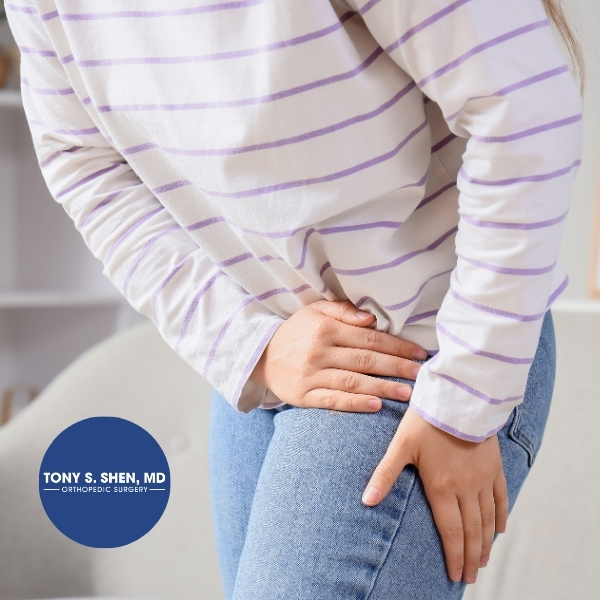
Groin pain is one of the most commonly misunderstood symptoms in orthopedics. Patients feel discomfort in the groin — the crease between the abdomen and thigh — and assume the problem is a muscle strain, hernia, or something urological. Many spend months, sometimes years, seeing different specialists before someone finally suggests the actual source: the hip.
The hip and the groin are anatomically connected in ways most patients don’t realize. Pain from a hip problem often shows up in the groin. It can radiate to the front of the thigh, the buttock, or even the knee. Because the pain doesn’t necessarily hurt where the actual problem is, adults with hip conditions frequently spend far longer than they should reaching a diagnosis.
Understanding when groin pain means hip trouble—and when it’s something else—helps patients get the right care sooner. And for hip conditions, earlier diagnosis often means better outcomes.
At HSS Long Island in Uniondale, Dr. Tony Shen evaluates adults with hip pain and groin pain across a wide range of conditions. Here’s what patients and their families should understand about the connection.
Serving Long Island patients from HSS Long Island in Uniondale — minutes from Garden City, Hempstead, Westbury, and East Meadow—call (212) 224-7988 to schedule your consultation.
Why the Hip Refers Pain to the Groin
The hip joint is surprisingly deep in the body. It sits beneath significant muscle and tissue — meaning that when it hurts, the pain doesn’t always appear directly over the joint. Instead, it commonly shows up in areas connected by shared nerve pathways.
The obturator nerve is a major nerve supplying the hip joint. It also supplies sensation to the inner thigh and the groin area. When the hip joint is irritated or damaged, the obturator nerve carries pain signals — and the brain often interprets those signals as coming from the groin rather than the deeper hip joint itself.
The femoral nerve contributes similarly. It innervates parts of the hip and supplies sensation to the front of the thigh and portions of the groin.
The connection between the hip and the groin isn’t a mystery — it’s basic anatomy. But because most patients don’t understand this connection, groin pain gets attributed to hernias, sports injuries, or muscle strains long before anyone considers the hip.
The result: hip conditions that could be treated relatively conservatively when caught early instead progress silently while patients pursue treatments for the wrong problem.
Common Hip Conditions That Present as Groin Pain
Several distinct hip conditions produce groin pain in adults. Recognizing the pattern helps identify which condition may be involved.
Hip Osteoarthritis
The most common cause of hip-related groin pain in adults. As the cartilage lining the hip joint wears down, patients typically develop:
- Deep, aching groin pain — worse with activity, better with rest
- Stiffness after sitting or in the morning
- Pain that gradually worsens over months to years
- Reduced range of motion — particularly difficulty rotating the leg
- Pain that may radiate to the front of the thigh or the knee
- Difficulty putting on socks, shoes, or getting in and out of cars
Hip osteoarthritis typically develops after age 50, though earlier-onset arthritis occurs — particularly in patients with prior hip injuries, developmental hip issues, or family history.
Femoroacetabular Impingement (FAI)
A structural condition where the ball of the femur (thigh bone) and the socket of the pelvis don’t fit together smoothly. This abnormal contact can damage the cartilage and the labrum (the ring of tissue around the socket).
Typical presentation:
- Groin pain that appears with hip flexion (bringing the knee toward the chest)
- Pain worse with prolonged sitting, running, or getting up from low chairs
- A characteristic “C-sign” — patients often gesture at their hip with a C-shaped hand to describe the pain location
- Symptoms in athletes, particularly those who play sports requiring deep hip flexion (soccer, hockey, dance)
- Onset often in the 20s to 40s
FAI is often missed because the pattern differs from arthritis — patients are younger, and the pain is more sport-specific.
Hip Labral Tears
The labrum is a ring of cartilage that helps stabilize the hip joint. Tears can occur from injury (a fall, athletic incident) or from underlying conditions like FAI.
Typical presentation:
- Deep, sharp groin pain
- Catching or clicking sensations in the hip
- Feeling of instability or the hip “giving way”
- Pain with pivoting or twisting movements
- May coexist with FAI
Labral tears are increasingly diagnosed as MRI technology has improved, and understanding of the condition has evolved substantially in recent years.
Avascular Necrosis (AVN) of the Hip
A condition where the blood supply to the femoral head is disrupted, causing the bone tissue to die. AVN can result from:
- Long-term steroid use
- Heavy alcohol use
- Prior trauma to the hip
- Certain medical conditions (lupus, sickle cell disease)
- Sometimes no identifiable cause
Typical presentation:
- Gradually worsening groin pain
- Pain at rest, particularly at night
- Progressive loss of hip range of motion
- Often affects patients in their 30s-50s
AVN is a condition where early diagnosis matters significantly — early-stage AVN can sometimes be managed with joint-preserving procedures, while advanced AVN typically requires hip replacement.
Hip Bursitis
Inflammation of the bursa (a fluid-filled sac that cushions the hip joint). While often causing pain over the outer hip, bursitis can also produce groin pain.
Typical presentation:
- Pain with activity, better with rest
- Sometimes worse when lying on the affected side.
- May be triggered by overuse, prior injury, or gait abnormalities
- Often coexists with other conditions.
Hip Dysplasia
A condition where the hip socket doesn’t fully cover the femoral head, creating instability and eventual joint damage. Often congenital but sometimes not diagnosed until adulthood.
Typical presentation:
- Groin pain that worsens with prolonged standing or walking
- Feeling of hip instability
- Often affects women more than men.
- May become symptomatic in the 20s-30s
Stress Fractures of the Femoral Neck
Uncommon but serious. Stress fractures of the femoral neck (top of the thigh bone) can present as gradually worsening groin pain, particularly in:
- Endurance athletes
- Patients with low bone density
- Women with menstrual irregularities and low body weight
Stress fractures of the femoral neck are one of the few “must not miss” causes of groin pain because untreated fractures can progress to complete femoral neck fractures.
What Groin Pain Is NOT (Sometimes) About the Hip
Not all groin pain is hip-related. Several other conditions can produce similar symptoms and need to be considered:
Hernias. Inguinal hernias produce groin pain that often gets confused with hip pain. Hernias typically involve a bulge in the groin, pain worse with straining or lifting, and pain that isn’t affected by hip motion.
Muscle strains. Adductor muscle strains (the “groin pull” familiar to soccer players and hockey players) produce groin pain that’s more superficial and directly related to specific movements.
Sports hernia (athletic pubalgia). A syndrome involving soft-tissue injury around the pubic bone. More common in athletes who make repetitive twisting and turning movements.
Urological or gynecological issues. Kidney stones, urinary tract infections, ovarian issues, and other conditions can present with groin pain.
Lymph node inflammation. Enlarged inguinal lymph nodes can produce groin pain, often with tenderness on palpation.
Referred pain from the spine. Sometimes L1-L2 nerve root irritation from the lower spine can produce groin pain.
Osteitis pubis. Inflammation of the pubic bone joint, often in athletes.
A good orthopedic evaluation distinguishes between these possibilities — often through physical examination, imaging, and careful history-taking.
Warning Signs That Suggest Hip Involvement
Certain features make hip involvement more likely and warrant orthopedic evaluation:
Pain that worsens with hip motion. If the pain gets worse with squatting, sitting cross-legged, getting out of a car, or rotating the leg, hip involvement is likely.
Pain that improves with rest. Hip arthritis and impingement typically improve with rest and worsen with activity.
Stiffness in the morning or after sitting. A classic sign of hip arthritis.
Reduced range of motion. If the affected leg can’t rotate as freely as the other, or you can’t reach as high with that leg, the hip is likely involved.
Pain radiating to the thigh or knee. Referred pain from the hip commonly travels down the front of the thigh, sometimes as far as the knee.
Gradually worsening symptoms over months. Hip conditions typically develop slowly, unlike acute muscle strains.
Difficulty putting on socks or shoes. A hallmark sign of significant hip stiffness.
Feeling of the hip “catching” or “clicking.” Suggests labral involvement or impingement.
Pain at night. Particularly worrying — may suggest arthritis, avascular necrosis, or other conditions that need evaluation.
Warning Signs That Require Immediate Evaluation
Certain symptoms warrant urgent orthopedic evaluation, not scheduled appointments:
- Sudden severe hip or groin pain without explanation
- Inability to bear weight on the affected leg
- Pain following a fall or trauma
- Signs of infection — fever, warmth, redness over the joint
- Numbness, tingling, or weakness in the leg
- Sudden change in leg length (one leg becoming shorter than the other)
- Progressive loss of function happening quickly.
- Groin pain in endurance athletes — possible stress fracture risk
Why Early Evaluation Matters
For hip conditions, early diagnosis typically improves outcomes. Here’s why:
Joint-preserving options exist early. Conditions like FAI, labral tears, and early hip dysplasia can often be treated with joint-preserving procedures (arthroscopy, periacetabular osteotomy) when caught early. Once significant arthritis develops, these options are less effective.
Cartilage damage is progressive. Untreated FAI, dysplasia, and other structural conditions typically continue to damage the joint over time. Earlier intervention often preserves more of the natural joint.
Compensation patterns develop. As people avoid painful movements, they develop gait abnormalities and muscle imbalances that create new problems (knee pain, back pain, opposite hip pain) even after the hip is treated.
Delayed diagnosis costs years of function. Patients who wait to see a specialist often spend years with reduced activity, worsening pain, and progressive limitations. Early diagnosis doesn’t necessarily mean early surgery — it often means starting non-surgical treatments (physical therapy, activity modification, injections) that can slow progression and improve quality of life.
Avascular necrosis and stress fractures have real windows. For these specific conditions, delayed diagnosis can turn treatable early-stage disease into severe conditions requiring more invasive care.
What Happens at a Hip Evaluation
For patients considering an orthopedic evaluation for possible hip-related groin pain, here’s what typically occurs:
Detailed history. The physician asks about when the pain started, what makes it better or worse, activities affected, family history of hip problems, and prior injuries.
Physical examination. A comprehensive evaluation of hip range of motion, strength, gait, and specific tests that reproduce the pain pattern. Certain physical exam maneuvers (the FADIR test, log roll test, and others) help distinguish hip pain from other sources.
Imaging when appropriate. X-rays are often the first step — they show arthritis, structural abnormalities, and some but not all conditions. MRI is used when soft-tissue injury (labral tears, AVN, stress fractures) is suspected. Not every patient requires advanced imaging.
Discussion of options. Depending on the diagnosis, treatment options range from activity modification and physical therapy to injections and, when appropriate, surgical intervention.
Realistic expectations. A good consultation should tell you not just what the diagnosis is, but what your realistic options are, how long each takes to work, and when surgery becomes the right consideration.
Treatment Options — From Least to Most Invasive
Most hip conditions can be managed conservatively before considering surgery. Common approaches include:
Activity modification. Reducing or modifying activities that provoke pain while maintaining overall fitness through lower-impact alternatives.
Physical therapy. Targeted programs to improve hip strength, mobility, and movement mechanics. Effective for many hip conditions, particularly when started early.
Weight management. For weight-bearing joints like the hip, even modest weight reduction significantly reduces stress on the joint.
Anti-inflammatory medications. Short-term or intermittent use for symptom management under physician guidance.
Injections. Corticosteroid injections, hyaluronic acid, and sometimes platelet-rich plasma (PRP) can provide symptom relief and help with diagnosis.
Hip arthroscopy. For appropriate patients with FAI, labral tears, or other specific structural problems, arthroscopic surgery through small incisions can address the underlying issue while preserving the natural joint.
Joint-preserving surgery. For younger patients with structural problems like dysplasia, more complex joint-preserving surgeries can sometimes delay or prevent the need for hip replacement.
Hip replacement. For advanced arthritis, avascular necrosis, or other conditions where the natural joint can no longer function, hip replacement remains one of the most successful procedures in orthopedics — with high patient satisfaction and long-lasting outcomes.
The right treatment depends on the specific condition, the patient’s age, activity goals, and how the condition has progressed.
Frequently Asked Questions
Why does hip pain show up in the groin?
The hip joint is deep in the body, and the nerves supplying it — particularly the obturator nerve — also supply sensation to the inner thigh and groin. When the hip is irritated or damaged, the brain often interprets the signals as coming from the groin rather than the deeper joint.
The hip joint is deep in the body, and the nerves supplying it — particularly the obturator nerve — also supply sensation to the inner thigh and groin. When the hip is irritated or damaged, the brain often interprets the signals as coming from the groin rather than the deeper joint.
How do I know if my groin pain is from my hip or something else?
Hip-related groin pain typically worsens with hip motion (squatting, sitting cross-legged, rotating the leg), improves with rest, and may be accompanied by stiffness or reduced range of motion. Non-hip causes usually don’t have this pattern. An orthopedic evaluation can distinguish between possible causes.
Hip-related groin pain typically worsens with hip motion (squatting, sitting cross-legged, rotating the leg), improves with rest, and may be accompanied by stiffness or reduced range of motion. Non-hip causes usually don’t have this pattern. An orthopedic evaluation can distinguish between possible causes.
Can hip arthritis develop before age 50?
Yes. While hip arthritis is most common after 50, earlier-onset arthritis occurs — particularly in patients with prior injuries, hip dysplasia, femoroacetabular impingement, or family history. Athletes in high-impact sports may also develop earlier-onset arthritis.
Yes. While hip arthritis is most common after 50, earlier-onset arthritis occurs — particularly in patients with prior injuries, hip dysplasia, femoroacetabular impingement, or family history. Athletes in high-impact sports may also develop earlier-onset arthritis.
What is femoroacetabular impingement (FAI)?
FAI is a structural condition where the ball of the thigh bone and the socket of the pelvis don’t fit together smoothly. The abnormal contact can damage cartilage and the labrum over time. It’s a common cause of hip pain in younger, active adults—often diagnosed in the 20s- 40s.
FAI is a structural condition where the ball of the thigh bone and the socket of the pelvis don’t fit together smoothly. The abnormal contact can damage cartilage and the labrum over time. It’s a common cause of hip pain in younger, active adults—often diagnosed in the 20s- 40s.
What is a hip labral tear?
The labrum is a ring of cartilage that helps stabilize the hip joint. Tears can result from trauma, sports, or underlying conditions like FAI. Symptoms include sharp groin pain, catching or clicking sensations, and feelings of instability.
The labrum is a ring of cartilage that helps stabilize the hip joint. Tears can result from trauma, sports, or underlying conditions like FAI. Symptoms include sharp groin pain, catching or clicking sensations, and feelings of instability.
Can I have hip arthritis without hip pain?
Interestingly, yes. Some patients with imaging findings of hip arthritis have minimal symptoms, while others with milder imaging findings have severe pain. Symptoms and imaging don’t always match perfectly. The clinical picture matters more than the imaging alone.
Interestingly, yes. Some patients with imaging findings of hip arthritis have minimal symptoms, while others with milder imaging findings have severe pain. Symptoms and imaging don’t always match perfectly. The clinical picture matters more than the imaging alone.
Do all hip problems require surgery?
No. Most hip conditions can be managed with conservative approaches — physical therapy, activity modification, weight management, and sometimes injections. Surgery is typically reserved for conditions that don’t respond to conservative treatment or for structural problems that require anatomical correction.
No. Most hip conditions can be managed with conservative approaches — physical therapy, activity modification, weight management, and sometimes injections. Surgery is typically reserved for conditions that don’t respond to conservative treatment or for structural problems that require anatomical correction.
When should I see a hip specialist instead of my primary care doctor?
Consider a specialist evaluation if groin or hip pain has lasted more than 4-6 weeks despite rest and modification, interferes with daily activities, is progressively worsening, or you’re unsure of the cause. Primary care can be a good starting point, but persistent or worsening symptoms warrant specialist evaluation.
Consider a specialist evaluation if groin or hip pain has lasted more than 4-6 weeks despite rest and modification, interferes with daily activities, is progressively worsening, or you’re unsure of the cause. Primary care can be a good starting point, but persistent or worsening symptoms warrant specialist evaluation.
How is a hip evaluation different from a general orthopedic evaluation?
Hip evaluations involve specific physical examination maneuvers designed to reproduce hip-related pain patterns and distinguish hip conditions from other causes. Specialists who focus on hip reconstruction have particular expertise in identifying subtle conditions and matching them to appropriate treatments.
Hip evaluations involve specific physical examination maneuvers designed to reproduce hip-related pain patterns and distinguish hip conditions from other causes. Specialists who focus on hip reconstruction have particular expertise in identifying subtle conditions and matching them to appropriate treatments.
Can I keep exercising with hip pain?
For most conditions, yes — but often with modifications. Continuing appropriate exercise usually helps maintain function and prevent muscle weakness. Safe activities depend on the diagnosis. A consultation with a specialist can help identify which activities to continue, modify, or temporarily avoid.
For most conditions, yes — but often with modifications. Continuing appropriate exercise usually helps maintain function and prevent muscle weakness. Safe activities depend on the diagnosis. A consultation with a specialist can help identify which activities to continue, modify, or temporarily avoid.
Schedule a Consultation With Dr. Tony Shen
If you’ve been dealing with groin pain — particularly pain that worsens with hip motion, feels deep and aching, or has progressed over time — an orthopedic evaluation may help identify whether hip involvement is the actual cause.
Dr. Tony Shen, MD, is a fellowship-trained orthopedic surgeon at Hospital for Special Surgery specializing in hip and knee reconstruction. Trained at Harvard University, Washington University School of Medicine, and Hospital for Special Surgery, he brings HSS-level expertise in hip conditions to Long Island patients at HSS Long Island in Uniondale. Schedule a consultation today. You’ll leave your consultation knowing what’s actually causing your pain, whether hip involvement is the source, and what your realistic options are — surgical and otherwise.


